A comprehensive range of sputtering materials and sizes available
Micro machined components in strategic materials such as molybdenum, tantalum, titanium and niobium
Garnet crystals and substrates for epitaxy
J-GRAPHENE is ahigh quality, low defect graphene dispersion
Czochralski (Cz) and float zone (Fz) for a large range of semiconductor applications
Scratch, indentation and wear testing all on one tool at nano and micro load ranges
3D non-contact profilometers for collecting and analysing sample height data
Robust, modular, and powerful pin on disc tribometers
Non-destructive measurement of internal material properties
Advanced 3D optical measurement solutions for quality assurance in production
Non-contact technology measuring real time strength and direction of electrical currents
Reproducing the wear interaction between a surface and the human finger
Measurement of surface tension between liquids and solids
Determining thin film properties by change in polarisation of light
Measuring thin film properties by reflection
Tribology testing in ambient or tailored environments
Real life testing of finished products in respect of resistance to hand abrasion
Scratch & indentation for hardness, elastic modulus, adhesion, cohesion plus more
Gain a deeper understanding of your materials
Measure surface roughness, form, profile, finish plus more
Low damage plasma enhanced chemical vapour deposition
Low damage etching and nano structuring
Deposition of layers in the nanometer scale
Deposition of coatings by the vacuum evaporation technique
Deposition of coatings by the sputtering technique
The dispersion, mixing, pulverization or emulsification of materials
Scintillator materials grown in crystal form
Scintillator material in organic form
Materials for the measurement of radiation dose
Sapphire in sheet, tube, rod and component form
LiF, Quartz or SiO2, InSb, Si, Ge, PET, ADP, Beryl, TlAP, RbAP, KAP and CsAP
Bespoke leak testing systems for small or large parts
Superb optical stability and unsurpassed shock and vibration resistance
The performance of a penta prism with more control and wavelength transmission
Beam alignment where three or more optical axes are required
Two-mirror optical assembly arranged at a 90-degree angle
Ball mounted hollow retroreflectors
Reflects light back towards it’s source with minimal scattering
A comprehensive solution for laboratories using several types of microscope and profilometer
Benchmark technology for 2D and 3D surface texture analysis and metrology, seamlessly integrates with profilometers and other surface measuring equipment
Conductive coating on one side to prevent EMI/RFI
Plastic optical filter with broadband AR coating on both sides
Privacy Glass & Light Control Film

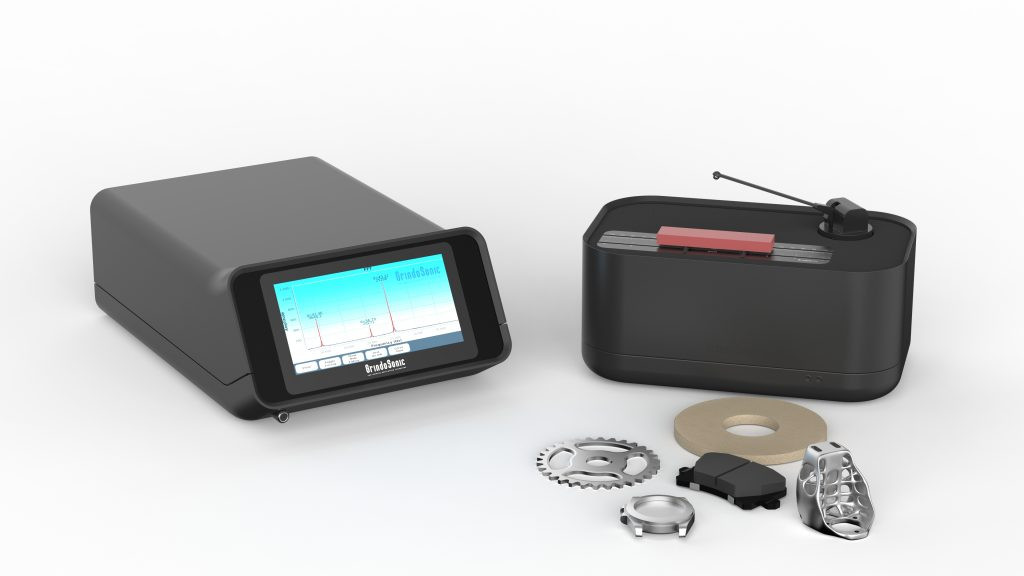
The GrindoSonic MK7 is a non-destructive testing (NDT) instrument and Impulse Excitation Testing System based on the Impulse Excitation Technique (IET) for measuring the resonance frequency of materials to determine key mechanical properties including Young’s modulus (elastic modulus), shear modulus, Poisson’s ratio, and damping capacity (internal friction).
This resonance-based method provides a fast, physics-driven way to evaluate material stiffness, structural integrity, and energy dissipation without damaging or altering the sample.
By analysing a material’s natural vibration response after a gentle mechanical impulse, the system can also detect subtle internal defects such as microcracks, porosity, voids, and structural inhomogeneity, making it highly effective for both research and industrial quality assurance.
Founded over 50 years ago, and with over 2000 systems installed worldwide, GrindoSonic is a recognised market leader in non-destructive testing based on the Impulse Excitation Technique (IET). GrindoSonic prides itself on state of the art equipment that is easy to use and that is backed up by excellent service.
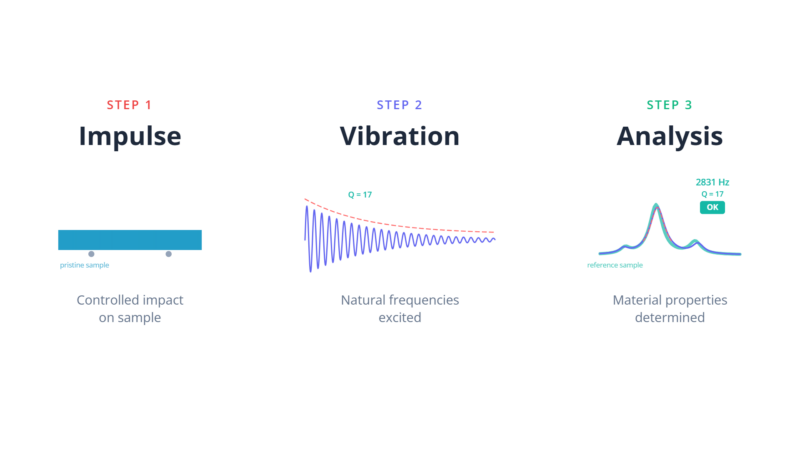
Impulse Excitation Testing measures mechanical properties by analysing the natural vibration of a material:
Because no permanent deformation occurs, the process is fully non-destructive, repeatable, and standards-compliant (including ASTM E1876, C1259, C215, E3397).

Core applications for Impulse Excitation Testing include:
In R&D, the ability to understand internal material characteristics without damaging your sample is priceless. The GrindoSonic MK7 tool measure Young’s and Shear modulus, Poisson’s ratio and Internal Friction of materials in a fast, accurate and non-destructive way. Researchers can either test directly on finished parts, or where suitable they can make identical test-bars out of different materials and then easily compare based on the resonant vibrations measured inside the bars using the GrindoSonic tool.
Because samples are not damaged during testing they can be tested time and time again. This is highly useful in applications where the evolution of material properties over time is critical. This could be used where a researcher wants to understand how a material ages over time, or when repeat testing parts to understand how they fatigue in real world situations.
Micro-cracks inside a product are invisible to the naked eye and even under a microscope, but they will have a direct impact on the damping of the resonance vibration. Therefore internal cracking can be characterised using the GrindoSonic MK7 tool.
Symmetric parts like tubes, cylinders or discs can be tested to quantify their asymmetry. Asymmetry is typically caused by geometric instability e.g. ovality, variations in density over the object, presence of internal defects like cracks, voids etc.
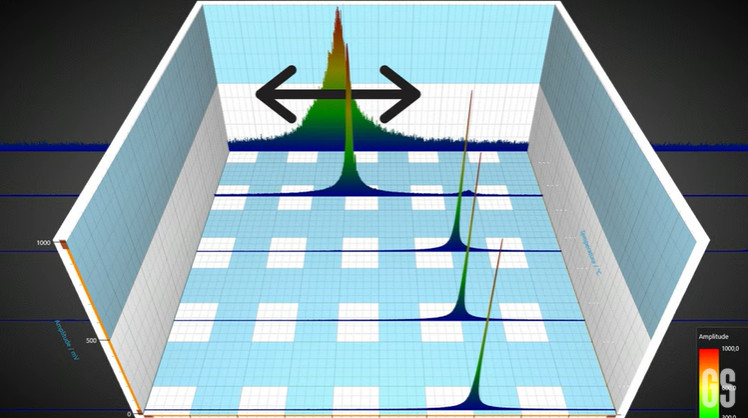
The distance between two frequency peaks (delta) is a metric for the asymmetry.
The Impulse Excitation Technique is a fantastic way of quality controlling parts without needing to damage them in any way. When causing a sample to resonate and measuring the frequency and damping the GrindoSonic MK7 is able to fingerprint a part. Therefore if other parts are exactly the same they should produce this exact same fingerprint when tested. Any deviation from this fingerprint indicates something in the part that is different, and therefore a quality control fail.
Using this method in quality control is fast, non-destructive and absolutely reproducible.
When fine-tuning a process, visual inspections or surface testing may not tell us anything about changes to the end product. With the GrindoSonic technique engineers can detect changes to the internal properties of a sample and therefore understand more about changes in material performance.
For example, a frequency drop might indicate a change in stiffness, hardness or porosity, whilst an increase in dampening could indicate the presence of cracks. The absence of a frequency all together could indicate a broken particle or internal stress.
GrindoSonic have proven expertise and experience across multiple industries such as:
| Frequency range | 20 Hz – 150 kHz |
| Frequency filter bands | 8 x 8th order band pass analog filters – 4 x programmable digital filters |
| System accuracy | Absolute accuracy greater than 0,005 % |
| Measurement resolution | 1/10.000.000 (0,1 ppm) |
| System repeatability | 3/10.000.000 (0,3 ppm) |
| Sample frequency | 10 kHz – 1 MHz |
| Number of samples | 1k-524k |
| System display | 7-inch multicolor touch screen |
| Data storage | 10GB (optional up to 58GB) and stored as .csv files |
| Network connection | Ethernet cable |
| Power supply | 100 – 240 VAC / 50-60Hz / max. 42W |
| Protection classification | IP50 |
For more information you can visit the GrindoSonic website at https://grindosonic.com/.
What is Impulse Excitation Testing?
Impulse Excitation Testing is based on the Impulse Excitation Technique (IET) which is a non-destructive testing method used to determine a material’s mechanical properties by analysing its natural resonance vibrations. A sample is lightly tapped to induce vibration, and the resulting frequency response is measured. From this response, key properties such as Young’s modulus, shear modulus, Poisson’s ratio, and damping capacity can be calculated. Because it does not damage the sample, IET is widely used for quality control, research, and material characterisation across metals, ceramics, composites, and other engineering materials.
Why use Impulse Excitation Testing?
The Impulse Excitation Technique (IET) is used because it provides fast, accurate, and fully non-destructive measurement of key mechanical properties such as elastic modulus, shear modulus, Poisson’s ratio, and damping. Unlike destructive testing methods, it allows the same sample to be tested repeatedly over time, making it ideal for research, ageing studies, and quality control. IET is also highly sensitive to internal defects such as microcracks and porosity, enabling early detection of material issues without damaging the part. Its speed, repeatability, and compliance with international standards make it a trusted method in both laboratory and industrial environments.
Resources related to the GrindoSonic MK7 Impulse Excitation Testing System.


We’re here and ready to provide information and answers to your questions
©Mi-Net 2023. All Rights Reserved.
Website by Fifteen.co.uk